


[Provisional translation]
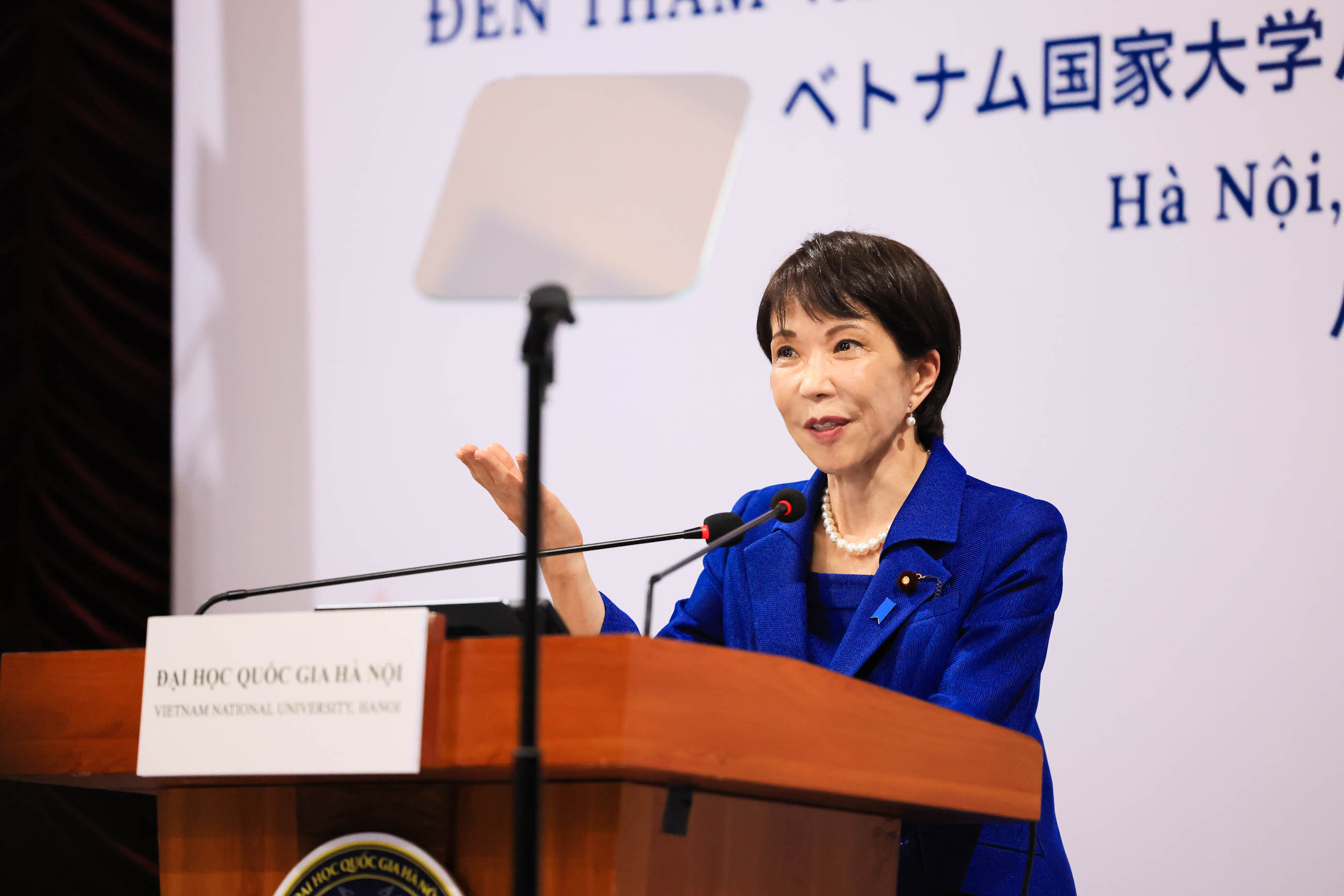
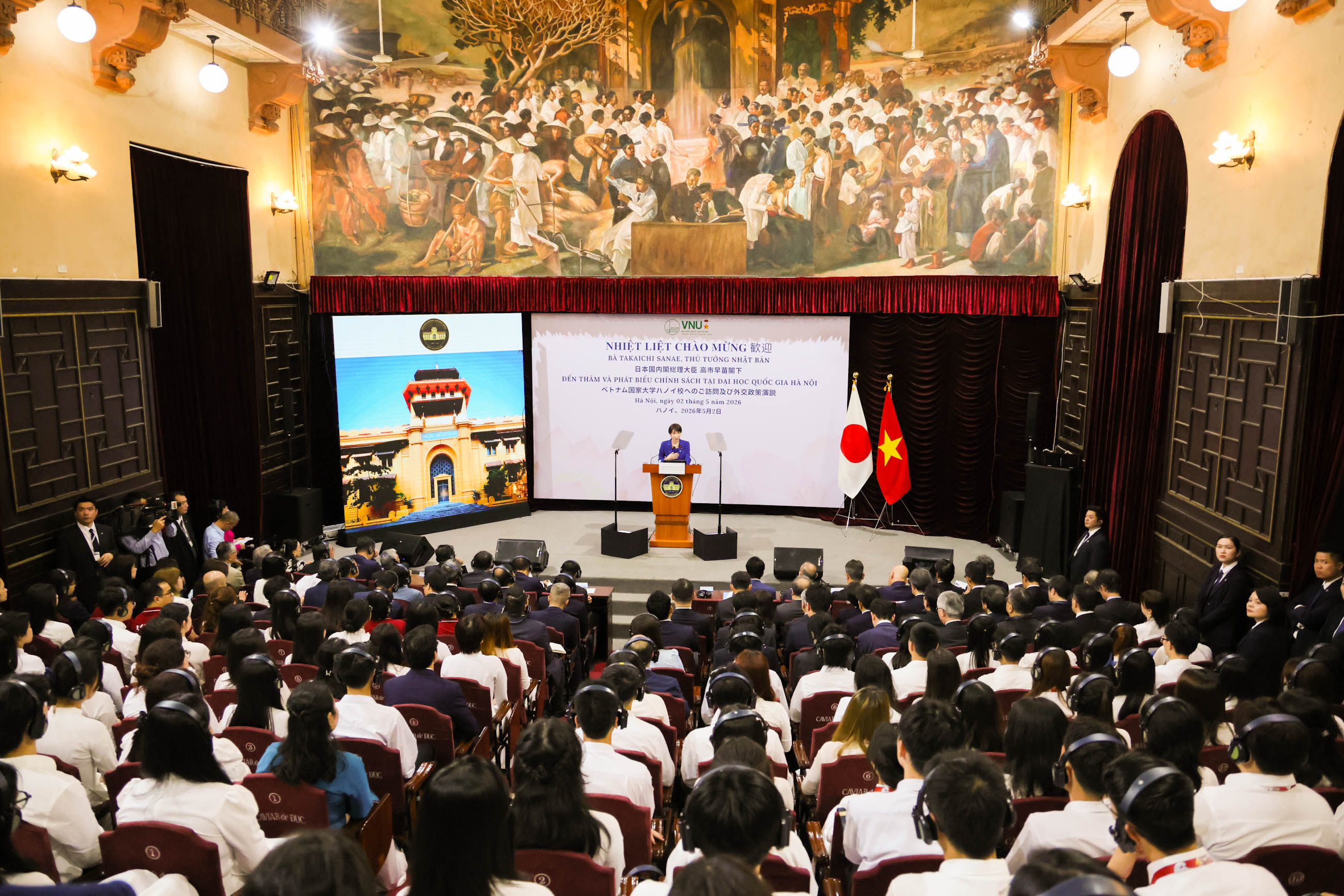
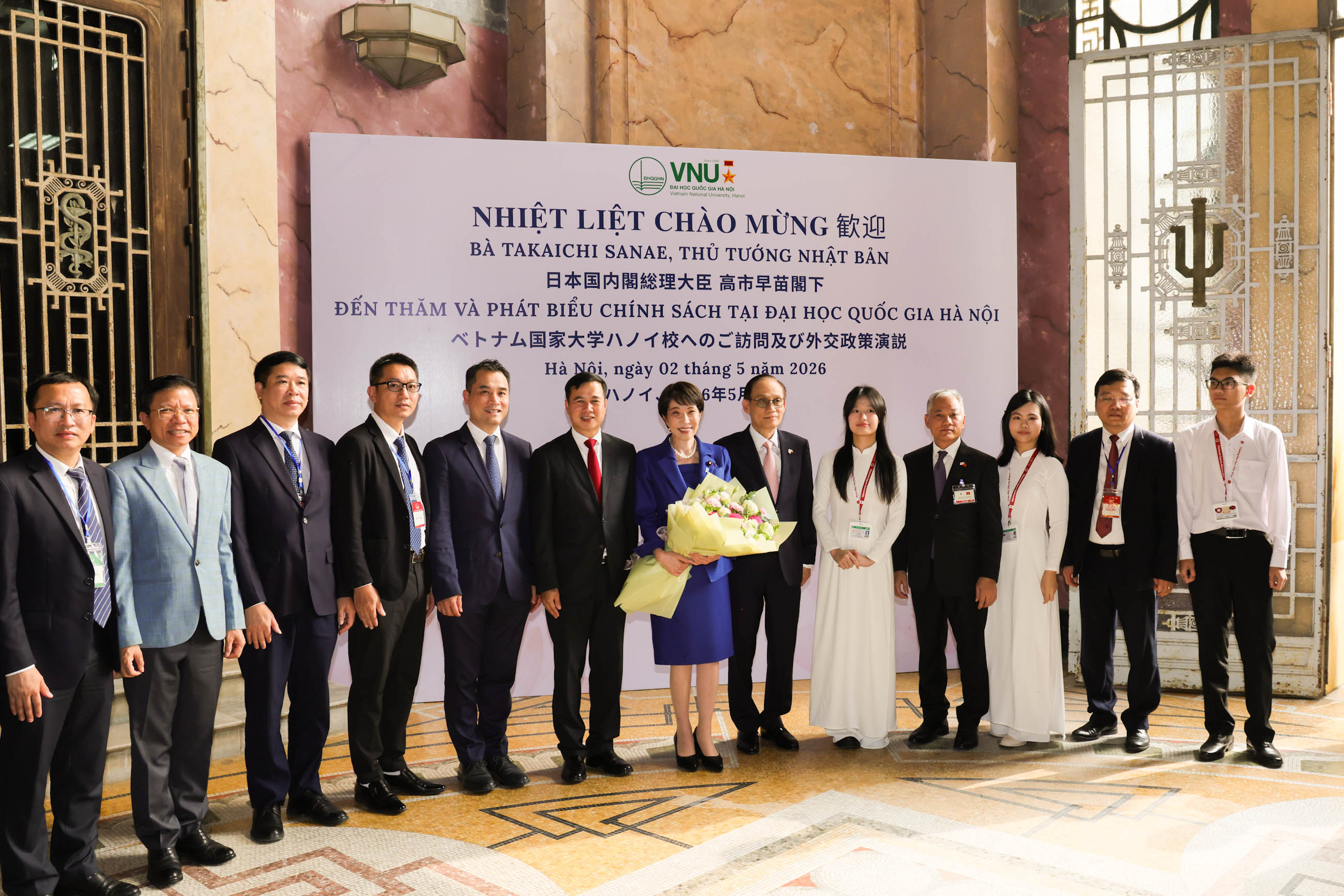
On May 2, commencing at 3:15 p.m. (5:15 p.m., Japan time) for approximately 25 minutes, Ms. TAKAICHI Sanae, Prime Minister of Japan, who is visiting Viet Nam, delivered a foreign policy speech at Vietnam National University, Hanoi, including the evolution of the Free and Open Indo-Pacific (FOIP).
H.E. Mr. Le Hoai Trung, Minister of Foreign Affairs of Viet Nam, and Mr. Bui The Duy, President of Vietnam National University, Hanoi attended the event.
- Prime Minister TAKAICHI referred to the history of exchanges between Japan and Viet Nam and to the importance of Viet Nam as a hub in supply chains, and stated the potential for cooperation between the two countries in fields such as space, semiconductors, and critical minerals.
(1) Prime Minister TAKAICHI noted that ten years have passed since the Free and Open Indo-Pacific (FOIP) was proposed, and referred to the commonalities between FOIP and the ASEAN Outlook on the Indo-Pacific (AOIP) advocated by ASEAN. Prime Minister TAKAICHI stated that, in the Indo-Pacific region which holds the key to peace and stability of the future international community, Japan would play an even more proactive role than ever before in fulfilling its responsibilities and contributing to the building of an international order based on freedom, openness, diversity, inclusiveness, and the rule of law.
(2) Prime Minister TAKAICHI stated that, in light of structural changes in the international order such as intensifying geopolitical competition, rapid technological innovation, and the rise of the Global South, it is essential for countries in the region to acquire autonomy and resilience in the economic, social, and security spheres in order to determine their own future in an increasingly complex web of interdependence, which is indispensable for realization of FOIP.
(3) Prime Minister TAKAICHI stated that Japan will update FOIP and work on three priority areas in order to strengthen the autonomy and resilience of countries: (1) building an economic infrastructure for the age of AI and data including strengthening supply chain resilience for energy and critical materials; (2) co-creation of economic growth opportunities through public–private collaboration and rule sharing; and (3) enhancing cooperation in the field of security to ensure regional peace and stability.
(4) Prime Minister TAKAICHI stated that Japan will accelerate its own efforts while working closely with like-minded countries to provide cooperation tailored to the needs of partners in the region, and expressed her conviction that, through these efforts, Japan and the entire Indo-Pacific region, including ASEAN, can become “stronger and more prosperous together.”
(5) Prime Minister TAKAICHI cited the following concrete examples of initiatives in the ASEAN region: (1) strengthening supply chain resilience through the “POWERR Asia”; (2) AI cooperation under the “Japan-ASEAN Co-Creation Initiative for AI”; (3) the FOIP Digital Corridor Concept including undersea cables, Open RAN, satellite communications, and all-optical networks, among others; (4) the expansion of the CPTPP; and (5) cooperation in the security field, including in maritime domain, through OSA, ODA, and other frameworks.
- Prime Minister TAKAICHI called for building a Free and Open Indo-Pacific in which autonomous and resilient countries cooperate with each other, thereby serving as the foundation for their peace and prosperity.