


[Provisional translation]
1. Opening Remarks
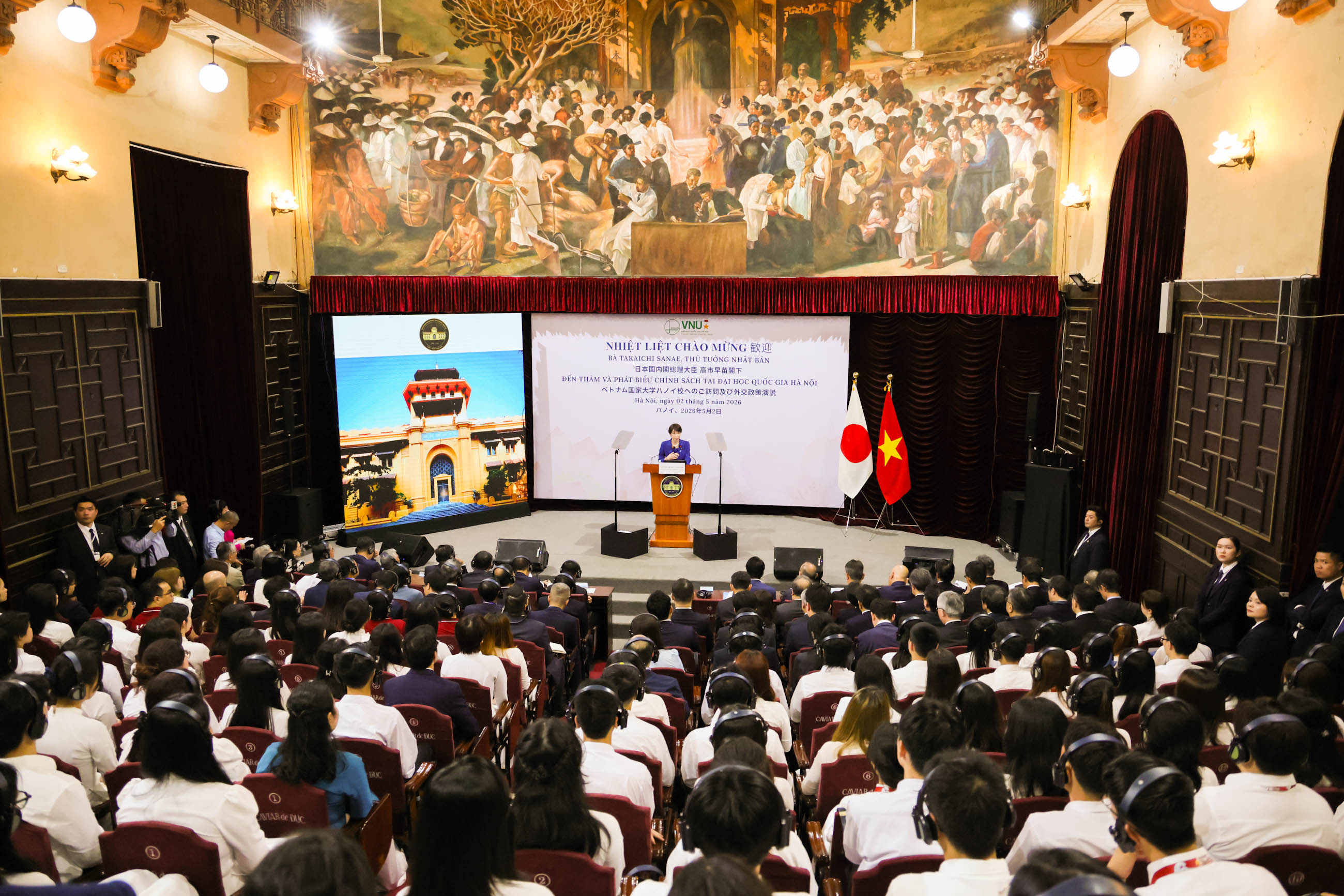
Dear students, esteemed faculty members of Vietnam National University,
H.E. Mr. Le Hoai Trung, Foreign Minister,
Mr. Bui The Duy, Director of Vietnam National University, Hanoi,
and distinguished guests,
Good afternoon.
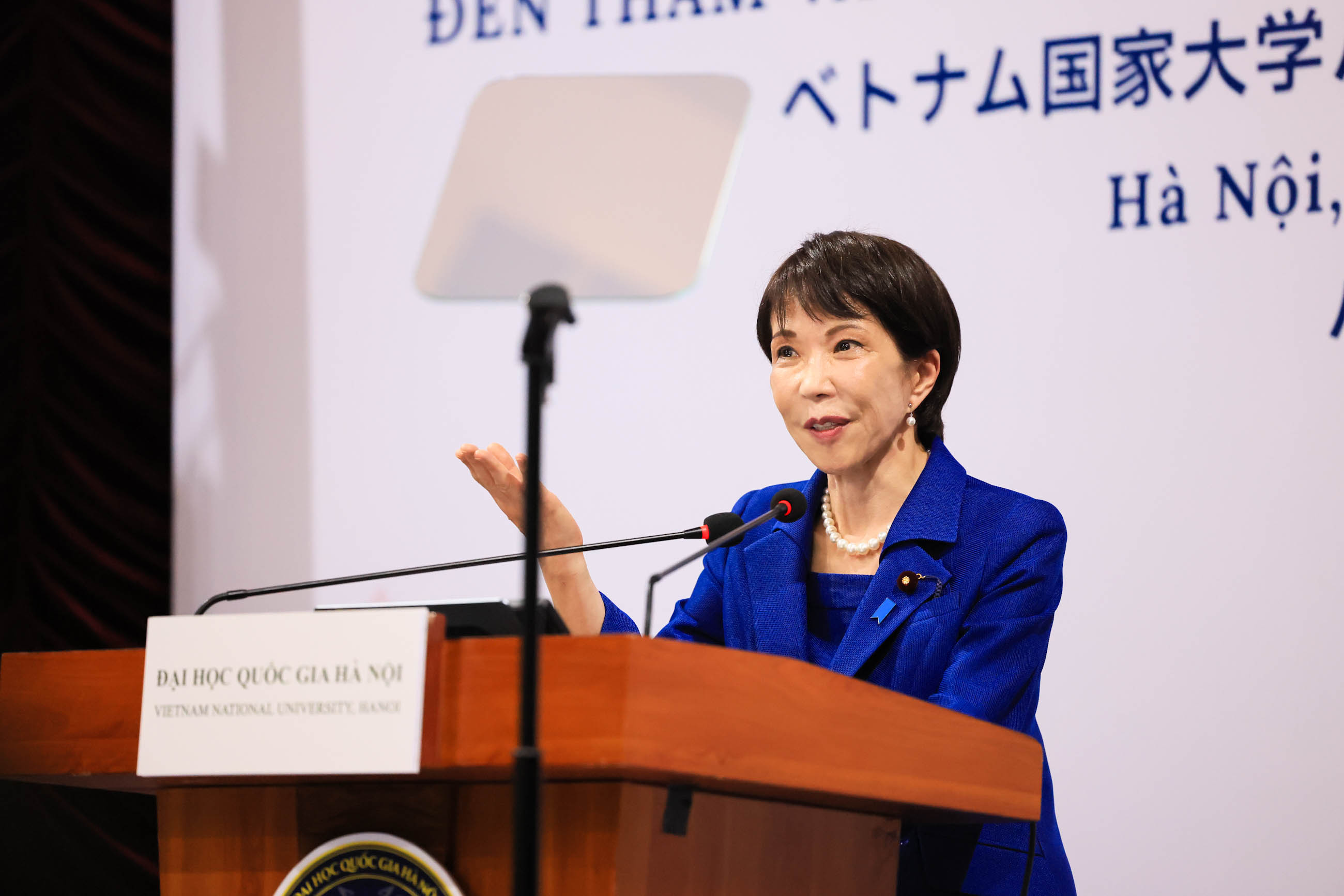
I am TAKAICHI Sanae, Prime Minister of Japan.
It is a pleasure to visit Hanoi once again. Six years ago, when I visited in my capacity as Minister for Internal Affairs and Communications, I was also warmly welcomed. It feels as if I have returned to my second home.
If I have another opportunity to visit Vietnam, I would very much like to visit Hoi An, a World Heritage site overlooking the vast Pacific Ocean. I wish to walk in the footsteps of the former Japanese community that once flourished there. In the old town, there is the “Japanese Bridge (Nihonbashi)”, whose restoration was completed two years ago with Japan’s cooperation. This bridge, which has withstood the passage of more than 400 years, tells the story of centuries of exchange between Japan and Vietnam.
More than 400 years ago, from the South China Sea, through the Taiwan Strait, and on to the East China Sea, Japanese and Vietnamese people engaged in dynamic trade. Together, we have enjoyed the blessings of free and open seas.
There are few partners who understand the value of this more deeply than we do.
With this spirit, in 2013, then-Prime Minister Abe chose Vietnam as the destination for his first overseas visit after taking office. With these thoughts in mind, I too have long looked forward to visiting Vietnam at the earliest opportunity since assuming my current post.
Today, I feel deeply honored to stand before you—the students who will shoulder the important role of carrying forward the long history of exchanges between our two countries into the next era, and who will bear responsibility for the future of Vietnam and Asia.
Before moving on to the main subject, let me begin with a brief quiz. Do you know what these are?
(Showing pictures of AirPods and the Nintendo Switch 2 on the screen.)
I am sure the students among you already know. Yes, these are Apple’s AirPods, which enjoy immense popularity among young people, and the Nintendo Switch 2, a product Japan takes great pride in.
Ten years ago, “Made in Vietnam” typically referred to clothing and textiles. Today, however, numerous global companies have established a presence in Vietnam, and many of the gadgets supporting youth culture are now manufactured here.
Moreover, many of these electronic products incorporate cutting-edge Japanese technology in their core components.
Vietnam’s manufacturing industry has now become an indispensable supplier to the global market, forging an inseparable relationship with the Japanese economy as well.
At the three Thang Long Industrial Parks near Hanoi, 205 Japanese companies operate, providing employment to approximately 100,000 people and serving as important hubs in the international supply chains for Japanese manufacturers.
For example, Canon procures parts from Vietnam, Japan, and elsewhere in Asia, and manufactures one in every four printers worldwide in Vietnam, shipping them to markets around the globe.
Today, I would like to speak about the future of the “Comprehensive Strategic Partnership” between Vietnam—a nation brimming with such vigor and hope—and Japan. Furthermore, I wish to explore what lies beyond: an updated “Free and Open Indo-Pacific (FOIP)” and its practical application in the ASEAN region.
2. The Future of Japan-Vietnam Cooperation
First, on the future of cooperation between Japan and Vietnam:
Let me begin by lifting our perspective far higher—indeed, to outer space, more than 100 kilometers above the Earth.
You may know that last month the United States’ Artemis II mission performed a lunar flyby, setting a new record for the farthest human spaceflight in nearly half a century.
Under the “Artemis Program,” Japan, in cooperation with the U.S., is developing a pressurized lunar rover that will allow humans to roam freely on the lunar surface.
As both China and Russia also pursue lunar exploration, the world is entering a new era of space development.
In this context, in March, the Vietnam National Space Center, developed with Japan’s Official Development Assistance (ODA), opened at the Hoa Lac Hi-Tech Park in Hanoi.
This center supports the development of Vietnam’s space science and its opening indeed stands as a milestone in the Japan-Vietnam space cooperation, which is the result of years of sustained efforts over the past two decades since 2006.
By utilizing satellite data, we can contribute significantly to disaster prediction and responses to climate change throughout Vietnam, including its coastal and maritime areas, thereby ensuring the safety of each and every citizen.
The Earth observation satellite “LOTUSat-1,” Vietnam’s first domestically owned satellite, is being manufactured by a Japanese company, with support from Japan’s ODA (Official Development Assistance).
Our ambitions stretch further. Whether in leveraging space to solve pressing issues or exploring space itself, the possibilities are limitless. I envision a future where our two nations join hands to lead the way in space exploration – a future brimming with excitement and hope.
I understand that Japanese manga and anime are popular in Vietnam.
In “Space Brothers,” a story about two siblings aspiring to become astronauts, Dr. Sharon, a mentor of the protagonist Mutta Namba, offers the following advice:
“When you feel lost, choose what brings you more joy.” I sincerely wish the youth of Japan and Vietnam will pursue just such an exciting and joyful future together.
Our cooperation in advanced technology is not limited to outer space.
Both Japan and Vietnam share a cultural tradition in which rice is a staple, and we also share common ground in what is often called the “rice of industry” – semiconductors. We are also advancing cooperation in cultivating highly skilled industrial talent in this area.
Last year, the "Semiconductor Chip Technology Engineer Program" was newly established at the Vietnam-Japan University, a part of this Vietnam National University. This is expected to contribute not only to Vietnam’s industrial advancement but also to the strengthening of Japan’s semiconductor supply chain.
I hope that the Vietnam-Japan University, as a symbol of Japan-Vietnam cooperation, will further develop into a hub for nurturing and supplying talented individuals who will contribute not only to our two countries but also to the wider Indo-Pacific region, beginning with the field of semiconductors.
Let us now move beyond this “rice of industry” to the “vitamins of industry”, – rare earths. Vietnam is also richly endowed with rare earths which are drawing increasing attention for their strategic importance.
Japan is strengthening cooperation to make supply chains more resilient, and ASEAN is a particularly important partner. We also would like to advance concrete Japan-Vietnam public-private collaboration.
3. Free and Open Indo-Pacific (FOIP)
Having journeyed from outer space to the rare earths buried deep beneath our feet, let us now cast our gaze beyond the horizon.
I would now like to speak about Japan’s vision for a Free and Open Indo-Pacific, or FOIP.
Exactly ten years ago, during his visit to Kenya in 2016, Prime Minister Abe articulated Japan’s diplomatic vision.
He stated that the vast Indo-Pacific region, connecting the Pacific and Indian Oceans and the continents of Asia and Africa, is the key to future international peace and prosperity. Japan would play an active role in upholding freedom from coercion, the rule of law, and market economies within this region, this is what he envisioned
This concept has since been widely shared as a clear vision of Japanese diplomacy, not only within Japan but also having an impact on the foreign policies of the United States and many other nations, and its circle of resonance has steadily expanded.
In 2019, ASEAN adopted the “ASEAN Outlook on the Indo-Pacific (AOIP),” which shares core values and spirits with Japan’s FOIP.
Last October, I, together with ASEAN leaders, adopted a joint statement confirming the synergy between FOIP and AOIP and the promotion of further cooperation—a vital guidepost for the Japan-ASEAN partnership.
Ten years have passed since FOIP was first proposed. The environment surrounding us has changed considerably, but the relevance of FOIP—which has made a significant mark on the world—remains unwavering.
As this region holds the key to the peace and stability of the future international community, I am renewing my determination to fulfill Japan’s responsibilities, and indeed, to play an even more proactive role than ever before in building an international order based on freedom, openness, diversity, inclusiveness, and the rule of law.
At the same time, we must adapt to new realities, the structural change in the international order, such as intensifying geopolitical competition, accelerating technological innovation, and the rise of the Global South.
More specifically, in this challenging environment, it is essential for countries in the region to acquire “resilience” and capability to have freedom to decide for themselves across the economic, social, and security domains so that they can determine their own future in the complex interdependent relations. This is indispensable to realizing FOIP.
To achieve this, Japan will update FOIP, focusing on three priority areas.
First, building economic infrastructure for the age of AI and data including strengthening supply chain resilience for energy and critical materials.
Second, co-creation of economic growth opportunities through public-private collaboration and rule sharing.
Third, enhancing cooperation in the field of security to ensure regional peace and stability.
Japan will advance its own efforts towards this end, and work closely with likeminded countries, will provide cooperation tailored to the needs of friends in the region. Through this, I am convinced that Japan, ASEAN, and the entire Indo-Pacific region can become “more resilient and prosperous together.”
Let me offer some concrete examples.
The ongoing crisis in the Strait of Hormuz is a direct test of Japan’s resolve to realize FOIP.
Many Asian countries, including Japan and Vietnam, depend heavily on crude oil from the Gulf states that passes through the strait. Should oil imports to Southeast Asia be interrupted, exports of chemical products such as naphtha to Asian countries would also cease.
To ensure a stable supply of petroleum products essential to economic activity and healthcare, Japan and ASEAN must jointly strengthen regional supply chains.
With this strong sense of urgency, I recently held an emergency online summit with Asian leaders and announced the “Partnership On Wide Energy and Resource Resilience Asia”—POWERR Asia. I would like to express my deep appreciation to Prime Minister Lê Minh Hung of Vietnam for his participation.
As an emergency response under this new partnership, Japan will provide financial support to local companies through JBIC (Japan Bank for International Cooperation) and NEXI (Nippon Export and Investment Insurance) for the procurement of fuel and other supplies, and will extend emergency yen loans to governments of Asian countries through JICA. As the first project under "POWERR Asia," Japan and Vietnam concurred to support through NEXI in order to procure crude oil for the Nghi Sơn Refinery.
Furthermore, as a medium- to long-term structural response, we will draw on Japan’s experience to build regional oil stockpiling and release systems, advance energy conservation, and using Japanese technology, develop and disseminate new energy sources such as biofuels, next-generation solar power, nuclear energy and LNG to power.
These are initiatives befitting partners who confront immediate challenges while preparing for the future together.
However, energy is not the only issue that Japan and ASEAN must address together.
Artificial Intelligence (AI) is becoming an indispensable part of our daily lives. In this age of AI and data, winning the intensifying competitions should be a top priority for every nation. Yet, it is no longer easy for any one country to secure all the necessary computing resources, data infrastructure, and human talent alone. In this domain too, Japan seeks to move forward together with Vietnam and other like-minded countries.
In October last year, we announced the “ASEAN-Japan Co-Creation Initiative for AI.”
Let us give concrete shape to this initiative and aim to develop AI models reflecting Asia’s diverse languages and cultures. Together, let us advance the development of native-language AI and industry-specific foundational models, the cultivation of advanced AI talent, and the improvement of digital infrastructure.
Building reliable communications infrastructure for massive data exchange is also an urgent task.
Leveraging its advanced technology and credibility, Japan will promote the development of undersea cables, Open RAN, satellite communications, and all-optical networks throughout the Indo-Pacific. I would like to call this initiative “the FOIP Digital Corridor Concept”.
In the Indo-Pacific, where supply chains cross national borders in complex ways, maintaining and expanding a rules-based economic order is indispensable for sustainable economic growth.
Together with Vietnam, the chair of this year, Japan will promote the expansion of the CPTPP. Particularly, Japan aims for early commencement of accession processes for strategically important applicants such as the Philippines, Indonesia, and the United Arab Emirates (UAE).
It is also necessary to update the rules.
Excessive dependence on a single country for critical goods often arises from unduly low prices. To strengthen supply chain resilience, it is essential to ensure a level playing field that incorporates factors other than price.
Furthermore, we will work to strengthen rules in areas such as e-commerce and supply chain resilience, and to address market-distorting practices and economic coercion.
Although I have spoken mainly about business and economic development, cooperation in security is also essential for realizing FOIP.
Regional peace and stability are fundamental prerequisites for economic prosperity, and regional supply chains are underpinned by the safe and open navigation of sea lanes.
Maritime security, a key element of FOIP.
Japan has consistently supported maritime security through the enhancement of maritime law enforcement capacities of Southeast Asian countries. Since 2014, Japan has provided vessels to Vietnam for maritime security and fisheries surveillance, and plans to build more vessels. Capacity-building assistance from the Japan Coast Guard has also been steadily provided. These seeds of cooperation are bearing fruit.
In the Philippines, across the South China Sea, the patrol vessels and radar systems provided by Japan serve as the “eyes” and “feet” that safeguard sea lanes.
Japan spares no effort in working together with ASEAN countries to uphold free and open seas.
Such assistance is also provided through the Official Security Assistance (OSA), established in 2023 to offer direct support to the armed forces of like-minded countries.
The first recipients were Southeast Asian countries—the Philippines and Malaysia; subsequently, Japan has built up a record of 16 projects in 11 countries from Asia, including Indonesia and Sri Lanka, to Africa, including Djibouti. We will further expand the scope and scale of OSA.
We will also enhance the use of ODA for security, supporting infrastructure development including ports and airports, as well as the maritime law enforcement capacities of like-minded countries.
4. Conclusion
What do you think?
As I hope my remarks have conveyed, Japan and Vietnam, and Japan and ASEAN, are cooperating across all domains—from the heights of outer space to the land, the depths of the earth, and the seas. Under the vision of FOIP, Japan seeks to unleash and nurture the hidden potential of our regional friends.
However, let me reiterate that most important point: it is you—the young generation—who will shape this future.
FOIP does not impose anything on anyone. It has grown flexibly, accepting a diversity of voices and adapting to the times. It is nurtured and evolves through your own voices—this is the very character of FOIP.
Japan has its own FOIP; Vietnam has its own FOIP.
Still, we all strive together for the peace and prosperity of the region, hand in hand.
In this way, resilient countries that own their choices cooperate, and together build a Free and Open Indo-Pacific as the foundation for their peace and prosperity.
This is the vision of FOIP as it marks its tenth year.
I sincerely hope that this encounter will serve as an opportunity for all of you—the young friends of the next generation—to reflect on the future of Japan, Vietnam, and the Indo-Pacific region, and to envision your own future within it.
Thank you very much for your kind attention.
Xin cảm ơn.
May 2, 2026
Vietnam National University, Hanoi, Vietnam
TAKAICHI Sanae
Prime Minister