


[Provisional translation]
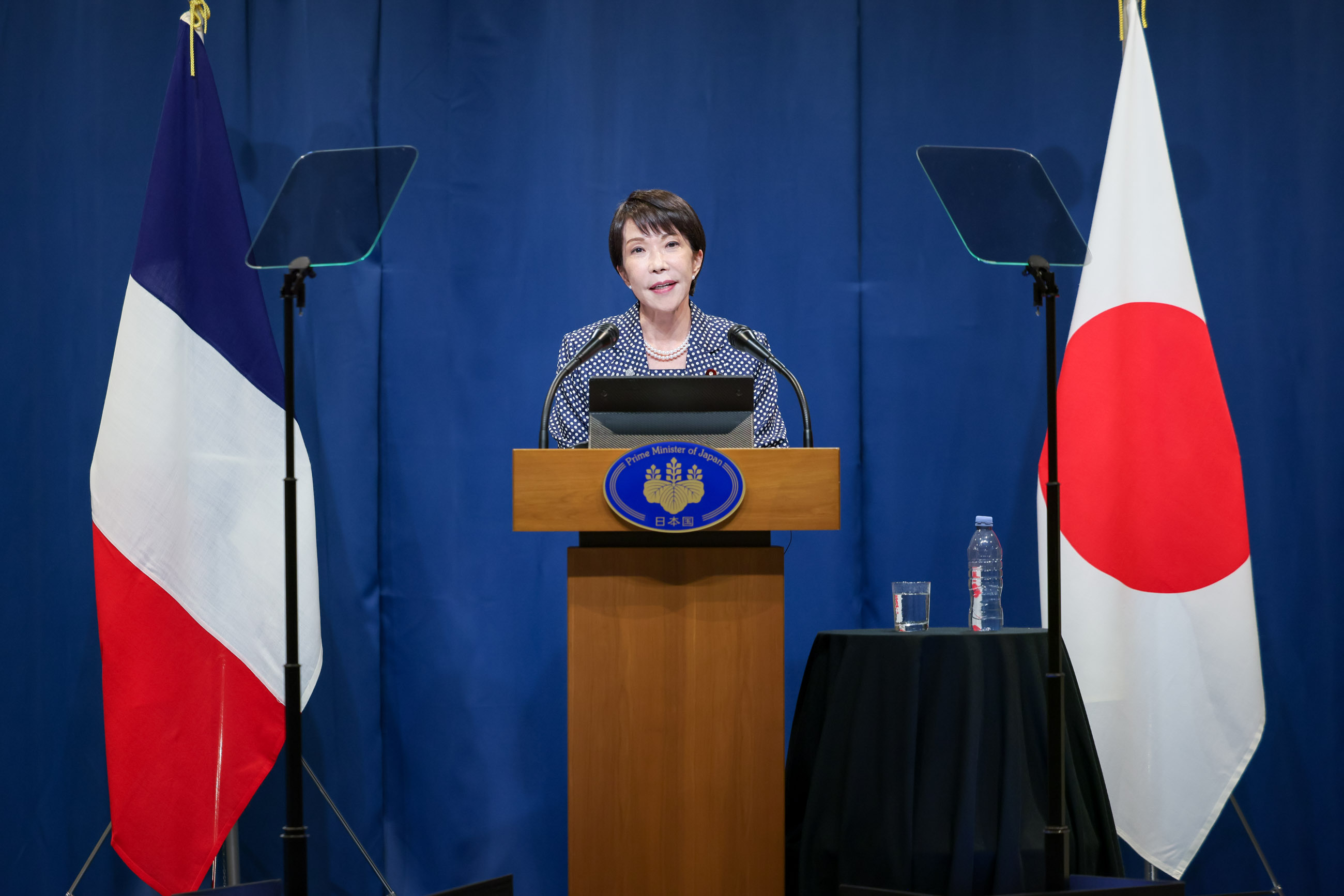
On June 17 (local time) in Archamps, France, Prime Minister Takaichi held a press conference regarding her visits to the UK and Italy, her attendance at the G7 Evian Summit in France, and other matters.
[Opening Statement by Prime Minister Takaichi]
Thank you all for coming.
Just now, the G7 Evian Summit drew to a close. As I begin my remarks, I wish to express my respect and appreciation to President Macron for demonstrating strong leadership as the chair of this year's summit.
Fifty years ago, the G7 we know today came into being. It was a time of turmoil in international financial markets triggered by the "Nixon Shock" as well as a time of global economic chaos resulting from the first oil shock. In the face of worldwide challenges no single country could resolve acting alone, what was needed was policy coordination among the major advanced economies at the summit level in areas such as the macroeconomy, trade, and energy. The G7 came about because the national leaders came to realize that acutely.
Later, the Cold War came to an end, and the 1990s were also marked by the Gulf War. Once we entered the 21st century, the fight against terrorism began. In the present day, Russia's aggression against Ukraine is dramatically shaking the post-war international older. In terms of the economy, the world has weathered both the Asian Financial Crisis and the Global Financial Crisis. Even during changes in the times as immense as these, the G7 leaders have engaged in candid, face-to-face discussions at least once a year and taken action by working hand in hand. The G7 has played a tremendous role in the resolution of global issues.
That is not simply because we account for a large portion of the global economy. The countries of the G7 share fundamental values such as freedom, democracy, basic human rights, and the rule of law. Grounded in this common foundation, we engage in frank discussions and take an aligned response to various global issues. I believe that is precisely what gives the G7 summit its significance, which remains undiminished even after half a century.
The world now finds itself facing unprecedentedly large challenges once more. I value the efforts toward peace made by the United States and Iran. That said, concerns over energy supply stemming from the situation in the Middle East have cast a large shadow over the global economy.
In April I hosted the Asia Zero-Emission Community (AZEC) Plus Online Summit, where I listened directly to the voices of the Asian countries impacted most severely. Here at this G7 summit, where Japan participated as the member from Asia, I put forward three proposals for fostering energy security, particularly the stability of the crude oil market.
My first proposal was for like-minded G7 member countries to act in cooperation in opposing unjustified export restrictions and ensuring free and transparent trade, to help bring about a stable energy supply. Free and safe navigation through all sea lanes, including the Strait of Hormuz, must be ensured.
Second, I proposed supporting the strengthening of oil stockpiles in Asia and elsewhere in a manner aligned with the International Energy Agency (IEA) 90-day stockpiling approach, in order to build supply networks that are resilient to these kinds of shocks. Japan is already taking the lead in this area by vigorously advancing the "POWERR Asia" (Partnership on Wide Energy and Resources Resilience Asia) initiative.
Third, I proposed strengthening dialogue and cooperation between oil-producing countries in the Middle East and elsewhere and oil-consuming countries. This will serve to neutralize coercive actions.
My way of thinking -- that the G7 should take the lead in advancing these three initiatives -- was fully in concert with the views of Prime Minister Starmer of the UK and Prime Minister Meloni of Italy, both of whom I visited in advance of the summit.
Beyond that, in the outcome documents from this Evian Summit, we as the G7 succeeded in sending out to the world a clear and unified message aimed at enhancing energy security. I consider that highly, highly significant.
The G7 was united in expressing its grave concerns over export restrictions and economic coercion regarding critical minerals and related items, which can impact global supply chains. I faithfully raised these issues occurring in the region during the G7 discussions.
Japan is the sole G7 member country with a critical mineral stockpile system for civilian use. Japan will make every possible effort to provide experience and know-how in that area.
The G7 will cooperate on joint stockpiles of critical minerals. This too is something that I proposed at this summit which received approval and was incorporated into the summit's outcome documents. What is important for rare earths and other critical minerals is reducing excessive dependence on a single country. That means expanding alternative procurement sources among the G7 and other like-minded countries. When putting this joint stockpiling cooperation into operation, we will establish switching supply sources as a condition for participating. As the G7, we laid out common dependence reduction targets and agreed to employ every possible means to achieve them, including demand-side policy responses.
At this summit we once again conveyed to the world a powerful message rooted in the fundamental values and principles that the G7 countries share in an unwavering manner, such as freedom, democracy, basic human rights and the rule of law.
Although less than eight months have passed since I took office as prime minister, I have built up personal relationships of trust with many national leaders, including the heads of the G7 nations. Building on that, at this summit we were able to engage in exceptionally candid discussions about the regional situation in the Indo-Pacific, various challenges in the region, including those related to China, and the abductions, nuclear, and missile issues related to North Korea, as well as my proposals on energy and critical minerals and other topics.
Also, President Lula of Brazil and I issued a leaders’ joint statement announcing the launch of negotiations on the Japan-MERCOSUR Economic Partnership Agreement (EPA) and confirmed that, while addressing each side’s sensitivities, we will realize a mutually beneficial agreement and further strengthen economic relations between Japan and MERCOSUR. Moreover, I enjoyed informal discussions with President Trump and held meetings with President Macron of France and President von der Leyen of the European Commission.
And, I believe that, in the same way it did half a century ago at its founding, the G7 succeeded in capably providing unified answers to current global challenges such as ensuring energy security and enhancing supply chain resilience.
Prior to the summit, I visited the UK and Italy, which are like-minded nations as well as fellow G7 summit member countries. We were able to engage effectively in close consultations at the summit level and vigorously chart a course forward in our bilateral relations.
With regard to issues surrounding economic security, Prime Minister Starmer and I issued the Japan-UK Joint Declaration on Economic Security Cooperation. We also issued the Japan-UK Frontier Technology Partnership in order to strengthen Japan-UK cooperation in the field of advanced technology, such as artificial intelligence (AI), and promote innovation to grow our economies.
I welcome Japan-UK cooperation progressing in increasingly concrete form through memoranda of cooperation being concluded between our countries' relevant institutions and businesses across a broad range of fields, including offshore wind power, nuclear power, cybersecurity, and semiconductors. We also confirmed we will advance our security cooperation, including through further promotion of the Global Combat Air Programme (GCAP).
Japan and the UK are Enhanced Global Strategic Partners and are both maritime nations, and we share strategic recognition including the inseparability of the security of the Indo-Pacific and the Euro-Atlantic. I believe that Japan and the UK are highly important like-minded countries that have been advancing pioneering cooperation in fields such as security, and that we have reached a level that could even be described as "quasi-allies."
When I visited the British Prime Minister's Office, I was received in a waiting room that successive prime ministers, including Prime Minister Margaret Thatcher, had used as their office. Reflecting on how Prime Minister Thatcher took on her duties, I renewed my determination, saying that I too will achieve necessary reforms with strong resolve.
Prime Minister Meloni of Italy and I issued the Japan-Italy Joint Statement on Space Cooperation. Building upon the strengthening of our bilateral cooperation in the field of economic security, which we agreed on the occasion of our January summit in Japan, in May the first meeting of the Japan-Italy Economic Security Consultations was held, and during this visit, a memorandum of industrial cooperation on strengthening supply chain resilience was signed. I am confident that through these, cooperation between Japanese and Italian companies will accelerate further across a wide range of fields, including semiconductors, critical minerals, and high technologies.
Prime Minister Meloni and I shared great expectations for the Strait of Messina Bridge Construction Project, in which a Japanese company is participating, to become a major project symbolizing economic cooperation between our two countries. Villa Doria Pamphili, where our bilateral summit meeting took place, is a historic building constructed in the 17th century and the exquisite building and gardens impressed me greatly. We were able to hold in-depth discussions in that serene setting.
We will enhance our autonomy and resilience in economic security with like-minded countries that share our fundamental values by deepening our cooperation in concrete terms at the people-to-people level rather than only between governments. I believe that this overseas trip will further advance the updated Free and Open Indo-Pacific.
As I conclude my remarks, I wish to express my sincere appreciation to the people of the UK and Italy, who welcomed us with such warm hospitality, as well as to all those who worked so hard in convening the Evian Summit. Thank you very much. This concludes my opening statement.
(Reporter)
I am Kimura with Fuji Television. Thank you for taking my question. I would like to ask about foreign policy. As you mentioned in your opening remarks, developments in the Middle East were a major topic at your first G7 Summit as prime minister. Following the agreement between the United States and Iran on a Memorandum of Understanding toward ending the conflict and hostilities, at the G7, in what way did Japan contribute to the discussions on how to achieve de-escalation?
In addition, Japan has indicated it will join the joint statement issued by the United Kingdom, France, Germany, and Italy, but the statement includes references to mine-clearing activities. How will the Government of Japan respond in the future, including with regard to dispatching the Self-Defense Forces?
Furthermore, you presented Japan's proposals in the fields of energy security and critical minerals. Did these proposals receive support from the other G7 member countries, and how do you believe the proposals will contribute to enhancing the resilience of global energy supplies?
Finally, what discussions took place regarding the regional situation in East Asia, including China, and how do you view Japan's relationship with China going forward?
(Prime Minister Takaichi)
Regarding the Iran situation, first, I welcomed the agreement between the United States and Iran as a major step toward de-escalating the situation. I also stated that I strongly hope that the Memorandum of Understanding will be steadily implemented, that free and safe navigation through the Strait of Hormuz will be effectively secured, and that a final agreement on Iran's nuclear issue and other matters will be achieved as soon as possible.
At the same time, I emphasized the importance of ensuring safe passage through the Strait of Hormuz for all vessels that remain in the Persian Gulf. Furthermore, as the leader of the only country to have suffered the devastation of atomic bombings during war, I stressed that the international community, working closely with the International Atomic Energy Agency (IAEA), must prevent Iran from developing nuclear weapons.
With regard to your question concerning dispatching the Self-Defense Forces, no specific decision has been made at this time.
The joint statement Japan will join alongside the United Kingdom, France, Germany, and Italy also makes clear that any participation would be subject to constitutional limitations. I therefore believe it is essential to carefully assess both the recent agreement between the United States and Iran and the actual situation that follows from it.
Japan will continue to work closely with the international community and pursue every possible diplomatic effort, including support for future reconstruction, in order to achieve peace and stability throughout the entire Middle East region.
Turning to enhancing supply chain resilience, in particular, as the leader representing Asia, the region most heavily affected by the current situation in the Middle East, I stressed that the G7 should take the lead in strengthening global energy security, particularly the stability of crude oil markets. From that perspective, I presented to the other G7 leaders the three proposals I outlined earlier.
In addition, I proposed the Joint Stockpiling Cooperation Initiative for critical minerals that I mentioned in my opening remarks. Both proposals received support from my counterparts. I am strongly determined to expand the principles underpinning Japan's POWERR Asia initiative to the broader international community.
I also thoroughly explained Japan's views and positions regarding the situation in the Indo-Pacific and regional challenges, including those related to China and North Korea, all of which have a significant impact on international peace and stability as well as prosperity. The G7 leaders shared the view that we should continue to work together closely in addressing these challenges.
With regard to Japan's relationship with China, my policy has remained consistent since assuming office as Prime Minister: to comprehensively promote a "Mutually Beneficial Relationship Based on Common Strategic Interests" and build "constructive and stable Japan-China relations." Japan remains open to various kinds of dialogue with China, with such dialogues in fact now taking place at various levels. Based on this stance, going forward, we will continue to respond in a level-headed and appropriate manner from the perspective of Japan's national interests.
(Reporter)
Hello. Lucien Libert from Reuters. Prime Minister, how is Japan adapting its relationship with the United States amid uncertainties about President Trump's approach to traditional allies, and would Tokyo consider taking part in a multinational mission to secure shipping in the Strait of Hormuz? And also, what does Japan think a critical minerals trade bloc should look like, and how should it function? Do you want to continue bilaterally with the U.S. or seek a G7-led bloc?
(Prime Minister Takaichi)
At a time when the international situation is turbulent and becoming increasingly uncertain, a strong Japan-U.S. Alliance remains indispensable to maximizing Japan's national interests. There is no change whatsoever in our position that the Japan-U.S. Alliance constitutes the cornerstone of Japan's diplomacy and security policy.
President Trump and I will continue to advance high-quality Japan-U.S. cooperation across a wide range of areas, including national security, the economy, and economic security, on the basis of our strong relationship of trust.
With regard to a multinational mission in the Strait of Hormuz, at this point nothing has been decided in concrete terms regarding Japan's participation or what cooperation might look like.
First and foremost, as I mentioned earlier, we intend to carefully assess both the agreement recently reached between the United States and Iran and the situation that follows.
Japan will continue to work closely with the G7 and the broader international community. We will consider all necessary response measures, including all possible diplomatic efforts, to help ensure free and safe navigation through the Strait of Hormuz for vessels of all nations, and we will reliably execute things we are able to do.
Additionally, regarding critical minerals, as I mentioned in my opening remarks, I proposed a Joint Stockpiling Cooperation Initiative and called for accelerating further G7 cooperation.
In strengthening supply chain resilience, Japan will work closely with the United States while also cooperating with the G7 and other like-minded partners to establish practical frameworks grounded in the realities of the industries concerned.
(Reporter)
I am Gakuto with the Nihon Keizai Shimbun. Madame Prime Minister, you have put a lot of hard work into this first visit to Europe and your participation in the G7 Summit. I would like to ask a question regarding domestic affairs. At today's working-level meeting of the National Council on Social Security, a proposal was presented to reduce the consumption tax rate on food items to 1 percent for a two-year period beginning next April. Is this 1 percent proposal something you can accept, or do you intend to maintain committed to the 0 percent rate pledge appearing in your campaign platform? Please share with us your assessment of this proposal.
In addition, during the final phase of the current Diet session, deliberations are scheduled on legislation stipulated in [the Liberal Democratic Party's] coalition agreement with the Japan Innovation Party. In particular, the proposal to reduce the number of Diet members has drawn objections from various parties. Given that the ruling coalition does not hold a majority in the House of Councillors, how do you intend to secure the understanding of the other parties on this issue?
Finally, within the Liberal Democratic Party, some voices have expressed hopes for the Democratic Party For the People to join the governing coalition. May I ask once again for your views on this matter?
(Prime Minister Takaichi)
Thank you very much. As I am here in Europe today, my understanding is limited to the briefings I have received. I understand that at the working-level meeting, Chairman Onodera presented, as a way forward reflecting the discussions held to date, a proposal that first, consideration of the future framework for a refundable tax credit should continue; second, a finely targeted benefit system linked to income should be fully introduced in FY2029; and third, as an interim measure leading up to that, the consumption tax rate on food and beverages should be reduced to 1 percent for a two-year period beginning on April 1, 2027. In addition, as an initial step toward the full-scale introduction of the new system, it was proposed that income-linked, finely targeted benefits be introduced from FY2027 by utilizing income information that is currently available. Through these measures, the proposal aims, in overall terms, to achieve the effective elimination of the consumption tax burden on food and beverages. I have been informed that discussions were held on the basis of this proposal put forward by the Chairman.
With regard to the refundable tax credit and the reduction of the consumption tax rate on food and beverages as an interim measure in the period leading up to implementation, I have asked the National Council to deliberate these matters and I will not prejudge its conclusions. That said, I believe that the Chairman’s proposal presented today is intended to further refine and organize the issues while taking into account the views expressed by the various parties, with a view toward compiling an interim report. Going forward, I expect that adjustments made in working toward the interim report will proceed on the basis of this proposal, and I intend to follow those developments closely.
As to whether I can accept the proposal at this stage, my view is that it is essential to ensure both a sense of urgency and, above all, that the measures are implemented with sufficient speed, timeliness, and adequacy. That said, discussions are still ongoing toward a final conclusion, and I intend to continue monitoring those deliberations carefully.
With regard to the reduction in the number of Diet members, my understanding is that the ruling parties are currently actively preparing for the submission of a bill. As Prime Minister, I will refrain from commenting on individual members’ bills or bills that are expected to be submitted by Diet members in terms of their substance or how they are proceeding. That said, speaking in my capacity as President of the Liberal Democratic Party, I would like to emphasize that the Party is committed to faithfully implementing the agreements reached in our coalition accord with the Japan Innovation Party, including those measures that were set forth as part of our governing policy commitments.
With regard to your question on expanding the governing coalition, I will refrain from commenting, as the intentions of the others involved are also a factor that must be respected. However, as I have stated consistently since assuming office, I firmly believe that without political stability, it is not possible to advance either a robust economic policy agenda or a strong foreign and security policy. Accordingly, I am always mindful of and considering the measures necessary to ensure such political stability.
(Reporter)
I am MURAKAMI Sakura, with Bloomberg. Thank you for taking my question. I understand that, during your informal discussion with President Trump yesterday, you exchanged views on China and the situation in the Indo-Pacific. Did your discussion also touch upon the issue of Taiwan? If so, what did you discuss? More broadly, President Trump has recently made remarks regarding arms sales to the Taiwan authorities and related issues. Do you regard this stance as a matter of concern? Finally, as the United States appears to be recalibrating its engagement in the region, especially in light of the current war involving Iran, do you believe that it is now more important than ever for Japan to work together with its regional and Indo-Pacific partners?
(Prime Minister Takaichi)
During my informal discussion with President Trump, we exchanged views on the situation in the Indo-Pacific, including China. We also confirmed that we will continue to maintain close communication going forward. It is difficult to respond in greater detail than that, including with regard to the points raised in your question. That said, the President and I have, on numerous occasions, reaffirmed our cooperation toward realizing a Free and Open Indo-Pacific (FOIP).
Furthermore, the United States’ commitment to FOIP is mentioned explicitly within the U.S.'s National Security Strategy. Therefore, I do not believe it is the case that the United States’ interest in the Indo-Pacific is declining.
Against the backdrop of an increasingly severe international environment, it remains fundamental for Japan to further reinforce the Japan-U.S. Alliance, which serves as the cornerstone of peace and stability in the Indo-Pacific region. At the same time, we intend to reliably ensure peace and stability in the Indo-Pacific by deepening coordination and cooperation not only with Australia, India, the Philippines, and the Republic of Korea, but also with like-minded European partners, including the United Kingdom as well as Italy and France, all of which I visited on this occasion.